
Watch this space for updates on this! when my dad saw this hull he envisaged a paddle tug, two large twin paddles and a bow thruster!
He’s making great progress on this, having striped it down to a bare hull, carved lumps of and added lumps on!
!!Update!! 10th September 2019!!
This has been an interesting project, I had been looking unsuccessfully for a low end Mississippi paddle steamer that I can learn from and refurbish.
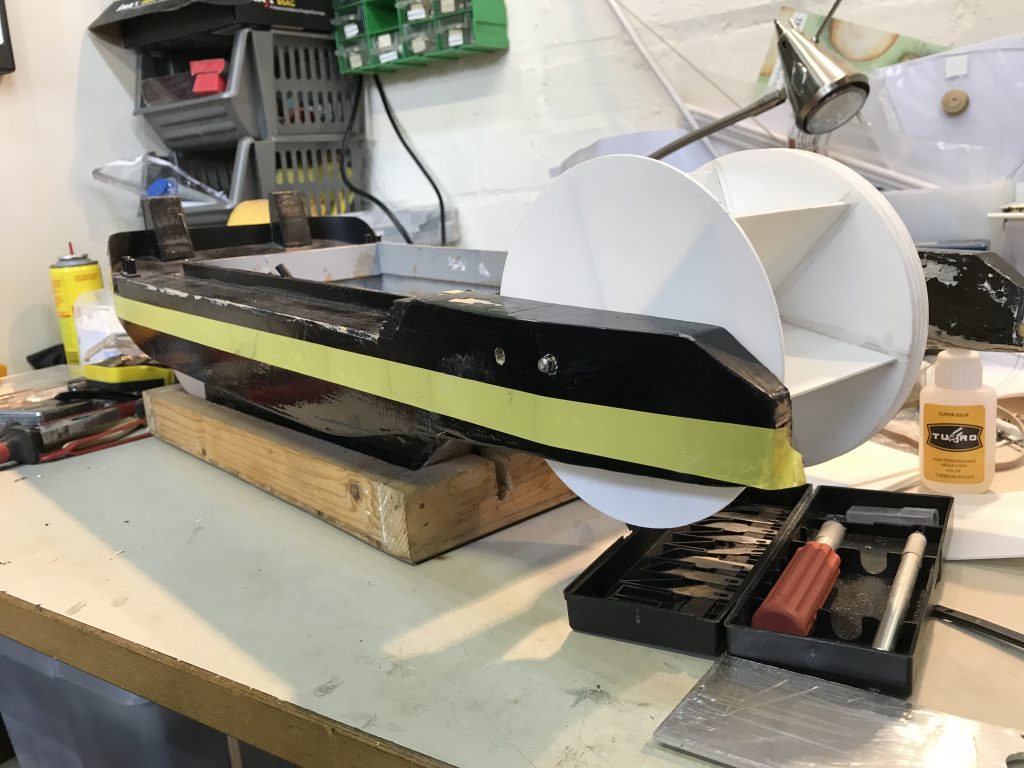
When my son acquired the Egret I was pleasantly surprised how it performed, particularly as it seemed to have been carved out of a solid tree trunk, or at least built from reclaimed floor boards, under the water the hull was just a box, flat front, sides and stern. We decided that by fitting twin stern paddles it could be an interesting paddle driven pusher tug.
Not having any knowledge of paddle boats I decided to check out any information I could find on the internet, there’s very little on this subject available.
As I didn’t know how this project would turn out I wanted to keep costs to a minimum and technically undemanding. I extended and rounded the bow, this is where the bow thruster will be fitted, and shaped the stern to allow a smooth flow of water to the paddle blades.
I read the best efficiency that can be expected from a paddle is 50 to 70%.

The best efficiency is obtained from ‘feathering’ paddles, that is where the blades are on pivots and connected by rods to an off center hub that makes them enter and leave the water at right angles to the surface, this is far too complicated for a first attempt, the second best is to have fixed blades that leave the water as upright as possible, this means that on entering the water the blade would be little more than horizontal but apparently this is ok, but this wouldn’t work for us as the paddles needed to have the same efficiency in reverse as forward, so I decided on fixed paddles equally spaced, there always has to be at least one blade in the water at all times so I worked this out to be six blades.
The paddle ends I made solid with the thought that less water would spill out the sides so more would go astern and create more push, and have less splashing, we’ll that’s my logic.
Why 2 paddles instead of one? With 1 paddle you would need rudders which in this instance would have to rely on the speed of the boat to have any effect, with 2 independent paddles you use tank steering instead of rudders.
In theory the boat would travel one circumference of the paddle with each revolution but in practice I read that this reduces by about 50%, I also read that the paddle should be turning somewhere between 40 and 60rpm.
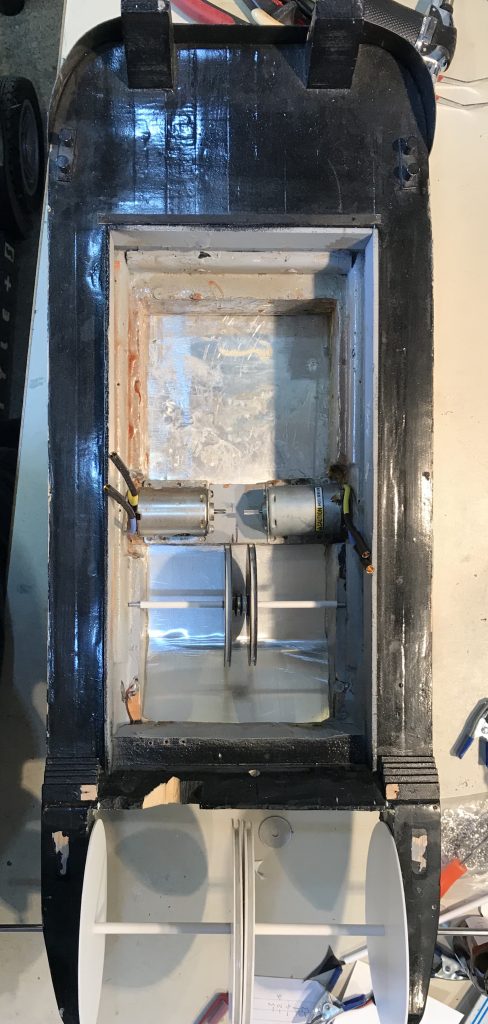
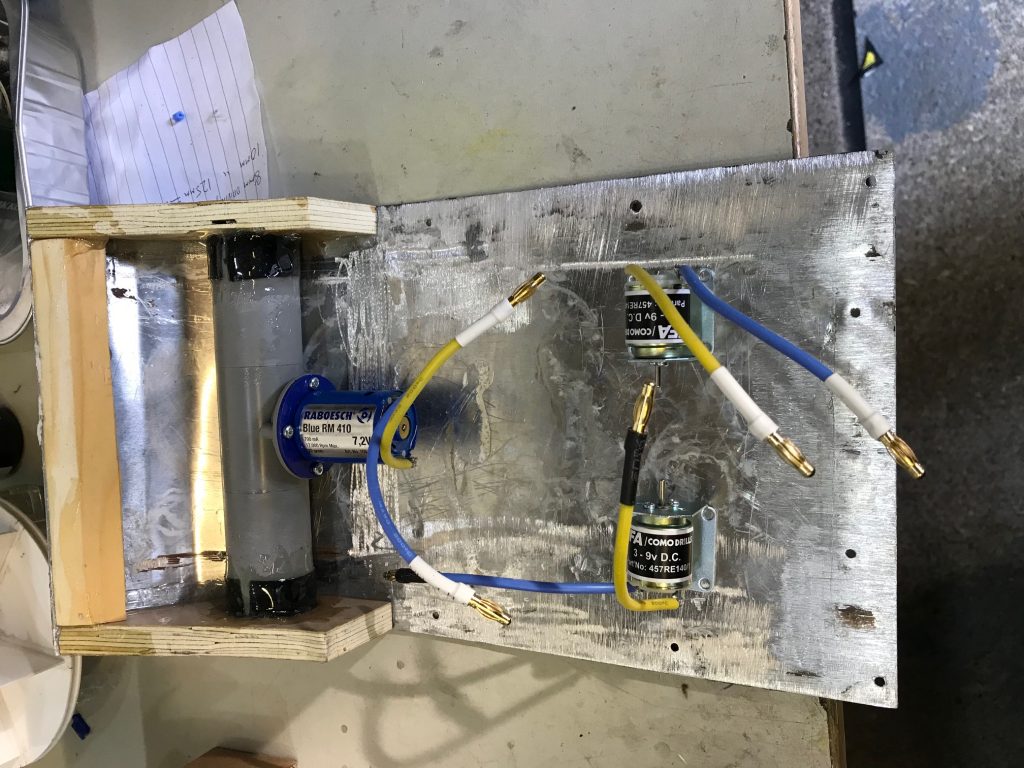
So now I have to decide how to transfer the motor rpm to the paddles. The motors that came with it revved to 18000rpm at 7.2volts, even gearing this down would be far too high, we decided that 2 smaller motors on 6volts would produce 7000rpm. Gears? Pushrods? No I thought pulleys would be easier to make, I turned 2x 8mm pulleys on the lathe in aluminum for the motors, they would drive 2x 80mm pulleys made of styrene giving a reduction of 10:1 bringing this shaft down to 700rpm then 2x 12mm pulleys would drive the 125mm paddles at about 70rpm max.
In contrast to the hull the styrene cabin is light in weight and quite nicely detailed, any changes to this such as lights etc. will be left to my son.
More to follow.


Update 16th October
I’ve decided that the small motors planned for this project are unlikely to have the required torque so I have ordered 2 motors with integral gearboxes geared to 600 rpm which are small and light enough to sit just above and inboard of the paddles and drive them direct, my calculations suggest they will have a free running speed of 53rpm, it will also be a simpler fit.
I now have the new motors, very small but lots of torque. Made motor mounts, fitted motors to them, made 2 drive belts, connected 7.4v lithium-iron battery’s, fitted 8mm pulleys to the motors, the paddles turned at 45rpm no load, I wanted them a little faster so I turned 2 pulleys in the lathe to 18mm, they now turn at 90rpm no load. Almost ready for basic trials.
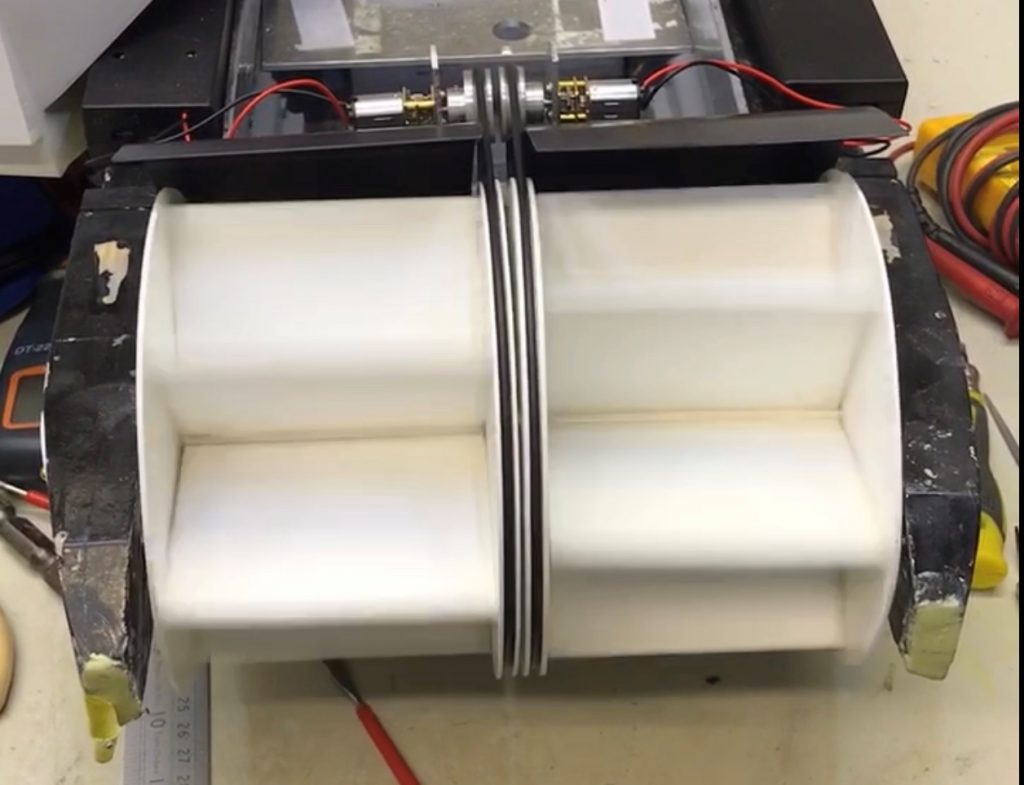
23-10-19
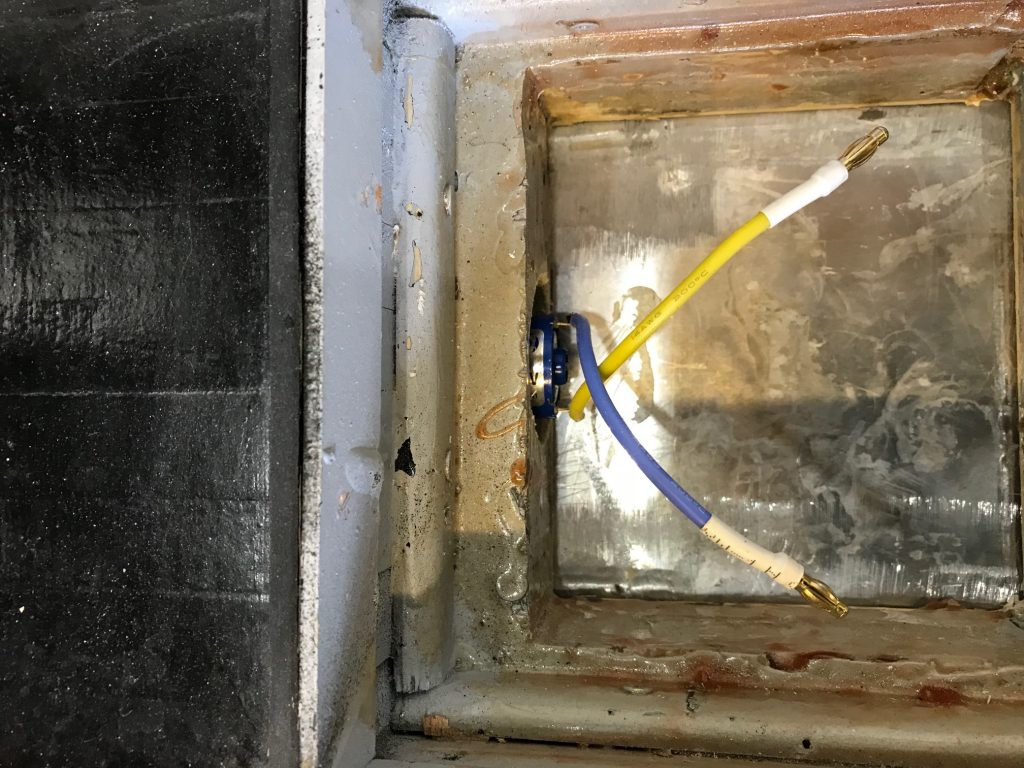
Initial testing showed up a minor leak in the sidethruster tube, a finger full of epoxy resin sorted it.
My son has decided that it needs faster revving motors, so direct replacements were promptly placed on order, so they will be easy to fit, he has plans to use a mixer to give various options controlling the sidethruster and the 2 rear paddles.
Jan 9th 2020
We’ve both been busy on other projects so this has been on a back burner.
As expected lake testing showed good and bad.
First the paddles ran at different speeds to each other especially at different throttle openings. Also the tank steering was ineffective but the bow thruster more than made up for this.
Reverse was totally ineffective, the wash from the paddle was hitting the stern underwater. We decided the paddles needed to be deeper. Gordon had a good idea, he knew someone who could 3D print some paddles, that would save me some time.
So we increased the paddles by 16mm diameter. When they came they were a little bit buckled, as they were going to be fixed together as one I bolted them together tight and that straightened them up quite a lot so I glued them at that.
Gordon sourced a high torque low rev motor. I need to work out what size pulley to make to turn the paddle at the required speed.
I’ve taken over the build again on this, and trial run with the new motor above!
Love the sound it makes but not much progress, I think having a solid paddle wheel is holding the water in place and making for a far to heavy wheel, I’ve decided to try and carve out the quadrants on the wheel to see if it spills the water as it turns, its all trial and error! a decent designer would have ironed out these issues before they had them I’m sure!
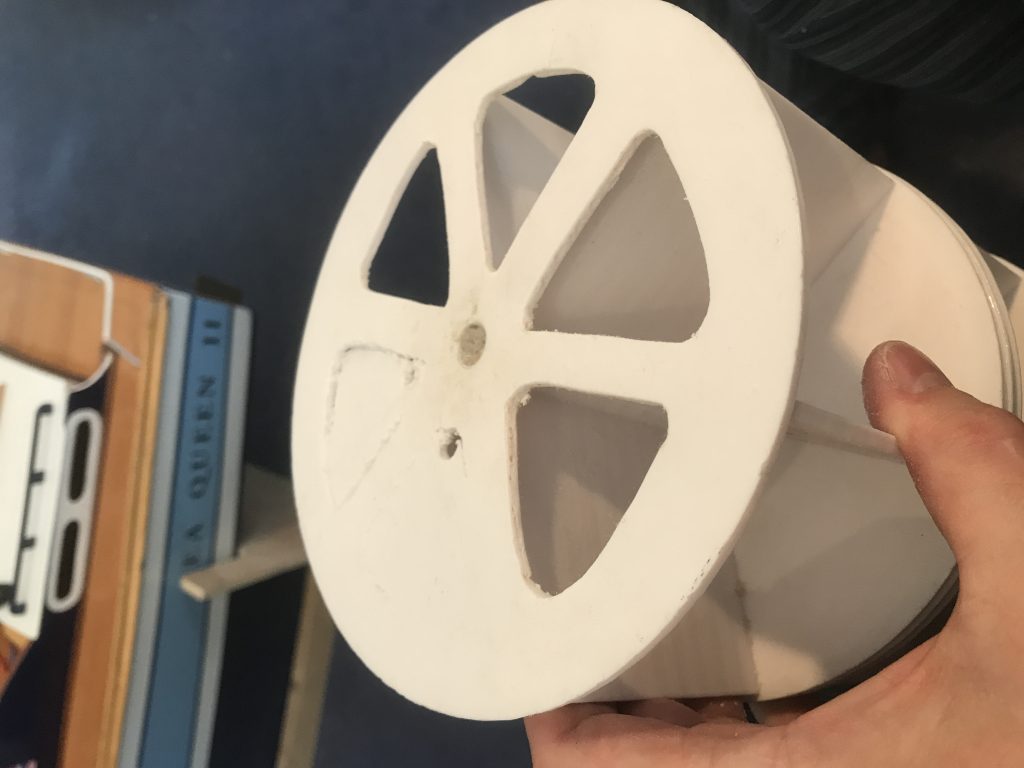
Broke a couple of jigsaw blades at first before resorting to using the dremmel.
Also have a bit of an issue with the paddles throwing water back into the boat, but one problem at a time!
Definite improvement with water spilling from the holes, but still sitting low at the back, my plan now is to add some buoyancy.